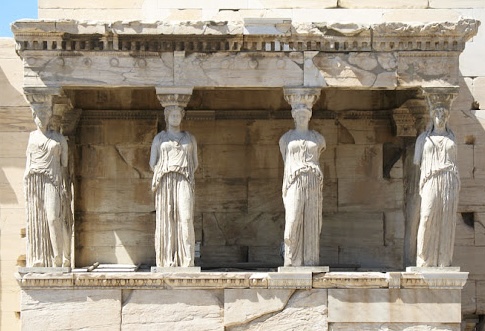
The classical era has made its stamp on today’s modern world of art, but not just by the influence of fancy pillars on esteemed buildings. Its influence branches further than the physical appearance of architecture and sculptures, it reaches the virtues and values we uphold today. One example is their caryatids, these sculptures serve multiple purposes: beauty, support, and a symbol of harmony. If you look at the Erechtheion, you’ll see that they’re unified by appearance and stance that creates a sense of order and peace. The way the women have their weight shifted on their outer legs provides the assurance of support and therefore adds to the sense of united peace. “This is a sort of sensitivity to harmony, balance…” Zucker, S., & Harris, B express. This technique used to represent these ideals is so effective that we imitate it in our art today. We have more tools than ever to pass down groups’ cultural morals and values to new generations such as animation. The Disney movie Brave used it to tell a story of what happens when you don’t have that unity.

In Brave, the mother Elinor is trying to teach her daughter Merida what happens if you don’t fulfill your duties as a political figure. She tells a story of an ancient kingdom, “… ruled by a wise and fair king who was much beloved. And when he grew old he divided the kingdom among his four sons. That they should be the pillars on which their piece of land rested.” Andrews, M & Chapman, B. (Directors). [13:10:00]. As Elinor tells the story she physically builds this kingdom with a chess board supported by four chess pieces under each corner. The chessmen she picks are white and are well detailed coincidentally alike how we view classical caryatids today. However one chessman is black and is clashing with the other three white pieces, it is this piece that represents the antagonist of the story at hand, “… But the oldest prince wanted to rule the land for himself, he followed his own path and the kingdom fell, from war and chaos and ruin.” As she recounts the kingdom’s demise, she snatches the black chessman from underneath the chess board and it tumbles to the ground along with all the other chess pieces who once relied on the foundationally chessmen to stay atop the board. Physically showing how imbalance, lack of order, or lack of symmetria, causes chaos.

These beliefs were once displayed on the architecture of buildings in Athens for all to see. All the youth of Athens had to do to see the virtues of their community was to walk outside. We don’t have as detailed architecture today to create rich storytelling for children, so we rely on other means. As a form of education and storytelling, animation has made a powerful impact on children’s lives. It’s no wonder they’ve looked back at the classical era for symbolism for intergenerational cultural transmission.
Citations
Andrews, M. & Chapman, B. (Directors). (2012). Brave [Film]. Walt Disney Pictures, Walt Disney Studios Motion Pictures.
Zucker, S., & Harris, B. (n.d.). The Athenian Agora and the experiment in
democracy. Khan Academy. Retrieved April 30, 2024, from
https://www.khanacademy.org/humanities/ap-art-history/ancient-mediterranean-ap/
greece-etruria-rome/v/athenian-agora
Zucker, S., & Harris, B. (n.d.). The Erechtheion. Khan Academy. Retrieved April
30, 2024, from https://www.khanacademy.org/humanities/
ancient-art-civilizations/greek-art/classical/v/erechtheion?modal=1
Leave a Reply