Vijayanagara architecture blends Hindu and Islamic styles, as seen in the Queen’s Bathhouse. It reflects how the Sangama brothers, Harihara I and Bukka, shaped a distinct identity for their newly founded kingdom in response to outside Islamic influence.
There’s some debate about whether the brothers came from the Kakatiya Kingdom or the Hoysala Empire (which eventually merged into the Vijayanagara Empire). Regardless, both these civilizations were Hindu-based and eventually overtaken by Muslim rule. In response to the Muslim invasion, the two brothers founded Vijayanagara. The rulers promoted the Hindu religion with festivals held in the capital and by building religious structures. The empire’s deep roots in Hinduism help explain architectural details such as the repeated lotus brackets on buildings, a Hindu symbol representing purity and divine beauty.
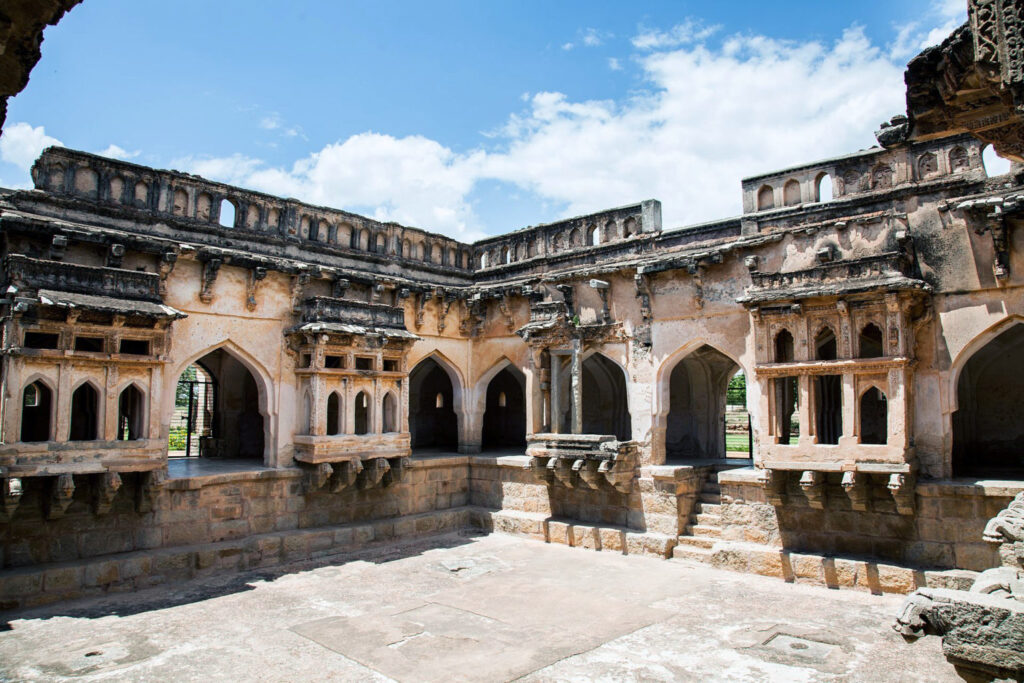
However, a question arises from the appearance of Islamic architecture, such as the pointed arches. Why would the Vijayanagara adopt these Islamic visual traits if they were resisting Muslim reign?
One of the most likely reasons is that the empire wasn’t cut off from the rest of the world. In fact, “…kings encouraged overseas trade from coastal ports that transported local goods for the international market…” (Pai). Not only did people visit for business, but also for tourism. The kingdom was lively, and as visitors described, it was “…a prosperous and well-planned city with irrigation technology, bustling bazaars, a large standing army, and sumptuous palaces,” (Pai) even comparing it to Rome. So of course, this was a hotspot for cultural exchange, including Islamic culture. Although they were resisting Islamic rule, it would be difficult not to subconsciously pick up on some of their familiar visual traditions. Elements like pointed arches and symmetrical architecture symbolize elegance, sophistication, and divinity. It’s logical that the kings would display these values in the Queen’s Bath, a place of royal leisure.
Alternatively, the choice to adopt a mixed Islamic and Hindu visual identity could very well have been intentional. On one hand, they were establishing Hinduism and resisting Islamic rule culturally. At the same time, they embedded Islamic architectural elements in the literal stone foundations of Vijayanagara’s most prestigious buildings, perhaps as a strategy to assert power. If they mimic the Islamic identity whose reign encompassed much of South India, then they could imply they had just as much power. Vijayanagara was trying to meet neighboring Islamic empires as an equal, so conveying that same strength through architectural language made sense for the City of Victory. This architectural blending of the two cultures reveals how imagery was used to define the “Self” in contrast to a perceived Islamic “Other,” reflecting the broader concept of imperialism as a cultural and political contest.
Citations
New World Encyclopedia contributors. (2023, May 3). Vijayanagara Empire. New
World Encyclopedia. Retrieved April 24, 2025, from
https://www.newworldencyclopedia.org/entry/Vijayanagara_Empire
Pai, G. V., Dr. (n.d.). Art and architecture of the Vijayanagara empire. Smart
History. Retrieved April 24, 2025, from https://smarthistory.org/
art-and-architecture-of-vijayanagara-empire/
Vijayanagara architecture. (n.d.). Wikipedia. Retrieved April 24, 2025, from
https://en.wikipedia.org/wiki/Vijayanagara_architecture?utm_source=chatgpt.com
Leave a Reply